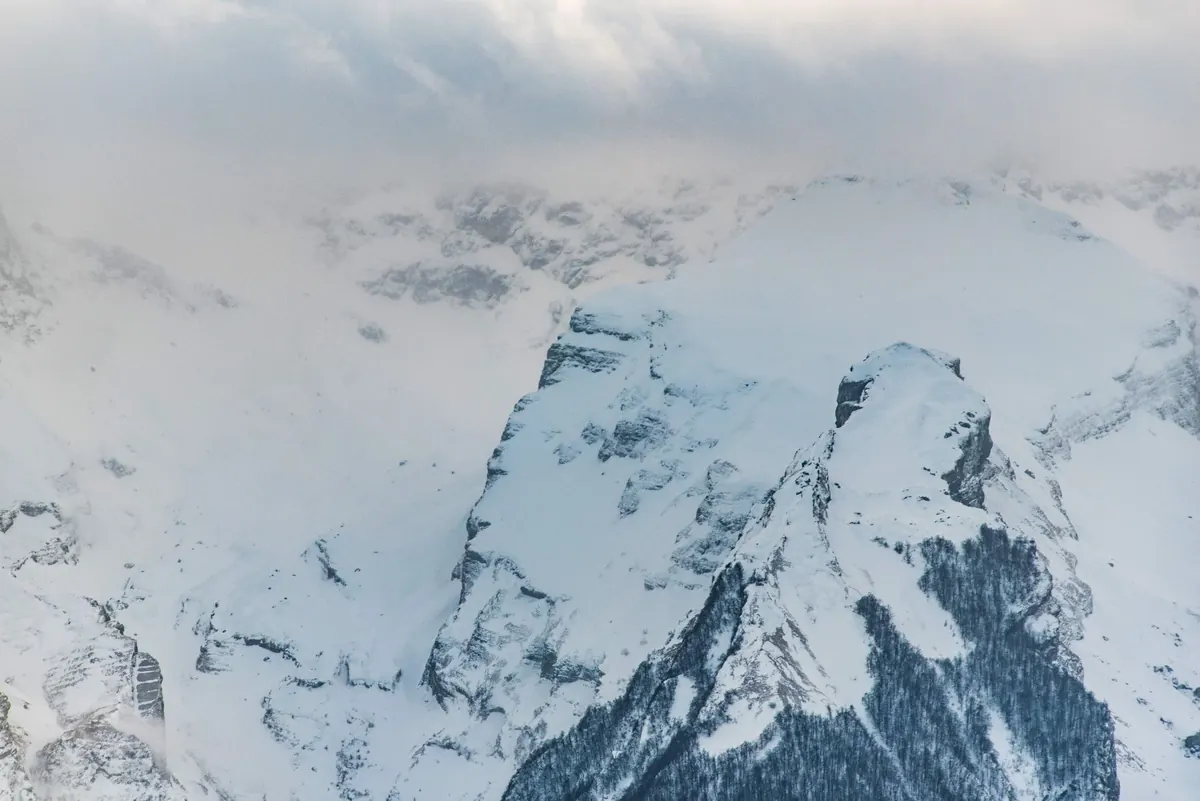
The cloud usually comes from below. One minute you are following a bootpack along a broad ridge, the light flat but workable; the next, the valley has filled in and the whiteness has climbed to meet you. There is no wind shift, no dramatic gust. The slope simply dissolves. You can still see your gloves, your partner's jacket, the tips of your skis. What you cannot see is the shape of the ground, the edge of the cornice, or which way it falls away.
That is the moment whiteout accidents happen — not because people panic, but because they keep moving on a picture of the mountain that is ten minutes out of date.
What a whiteout actually does
True whiteout is more than fog. When a cloud sits on snow, light bounces between the two and arrives at your eye from every direction at once. Shadows vanish. Slopes lose their shading. A thirty-degree pitch and a flat terrace look identical, and a crevasse or a convex roll can be invisible until you are on top of it.
Two things fail at once. Your navigation fails, because the features you were using — the rock outcrop, the gully, the line of trees — are gone. Your judgement fails too, and this is the part people underestimate. You cannot assess a slope you cannot see. You cannot tell whether that faint rise ahead is a safe ridge or a wind-loaded lip. You cannot see the snow surface well enough to read wind texture or recent drift.
Add cold, spindrift and the mild disorientation that comes from walking in a featureless sphere, and the sensible response is almost always to slow down or stop. The trick is to have decided that before you need to.
Route choice before you leave the car park
The best whiteout strategy is a route that does not require much seeing. Long before the cloud arrives, ask what the descent would look like blind. Ridges with big cornices, complex glacial terrain and wide open bowls with no defining features are all poor choices when contrast dies. A route with a handrail — a treeline, a stream, a piste edge, a fence, a marked path — gives you something to follow when your eyes cannot help.
Then record what you will need. Not in your head, and not in a pocket buried under three layers:
- The bearing of each leg of your intended route, written on the map or a card.
- Waypoints at the start, the high point, any junction and the point where you leave the ridge.
- An escape route — the lowest-consequence way off the mountain if the weather shuts in early.
- A turnaround time, agreed by the whole group, that has nothing to do with how anyone feels.
On a glacier or in avalanche terrain, this planning is not a solo exercise. If you are new to either, go with a qualified guide or take a proper course; the skills involved are not ones to learn from a screen.
Walking on a bearing when you cannot see
A compass does not care about the cloud. The difficulty is holding a line. Most people drift, and in poor visibility they drift consistently in the same direction, often downhill and often with the wind.
Break the terrain into short legs — a hundred metres, or whatever distance you can pace out reliably — and take a fresh bearing at the end of each one. Hold the compass flat, keep it in front of you, and pick a target: a partner, a ski pole planted ahead, anything you can see. Then walk to it, and only to it. Counting paces keeps you honest about distance and gives your mind a job, which helps with the strange drowsiness of featureless walking.
Use everything that agrees with everything else. An altimeter confirms you are where the map says. A GPS track shows the line you actually walked, not the one you think you walked — though in serious cold, batteries fade fast, so carry a spare and keep the device warm inside a layer. A back-bearing on a known point behind you is often more useful than the one ahead.
What you should not trust is the wind. Its direction shifts as you cross ridges and gullies, and it is exactly the sort of evidence that feels convincing and is wrong. The same goes for the slope angle underfoot: useful as a rough check, useless as a navigation tool.
Group checks that keep everyone accounted for
In flat light, groups string out. Someone stops to adjust a boot, the person ahead keeps walking, and within a minute there are two parties on the mountain instead of one. Tighten the discipline before visibility goes.
Agree that the leader stops at every change of direction and waits until the last person is in sight. Keep a nominated tail who counts heads at each stop and calls the number out loud. Pair people up so nobody is ever alone, and use voice contact as a check — if you cannot hear the person behind you, you are too far apart. In wind, agree on simple hand signals in advance, because shouting will not carry.
Nobody moves until everybody is ready. It is a slow rule that costs a few minutes and prevents the day's worst mistake.
Recognising the moment to retreat
Retreat is easy to describe and hard to do, because the mountain rewards momentum. Set your red flags in advance and treat any one of them as a decision point rather than a detail to debate:
- You have passed your turnaround time.
- You cannot identify the next feature on your route, and taking a bearing does not resolve it.
- The compass and the GPS disagree and you cannot explain why.
- Someone is cold, quiet, or slower than earlier in the day.
- The ground ahead is terrain you would not enter if you could see it clearly.
That last one matters most. In a whiteout you are effectively travelling without information, and the exposure that would be acceptable on a clear day — a steep face, a corniced ridge, a slope above a terrain trap — becomes a gamble. Turning around is not a failure of ambition. It is the plan working.
Getting down without drama
The safest descent in a whiteout is almost always the line you came up. You have already proved it goes, you know its shape, and your compass bearings reverse cleanly: add or subtract 180 degrees and walk them in the same short legs. If you saved a track, follow it back rather than cutting corners, because corners are where the unhelpful surprises live.
Move deliberately. Do not glissade into ground you cannot see the runout of. Stay well back from any ridge crest that might be corniced, and give a wide berth to slopes above you, since you cannot judge what is loaded. If the route down crosses avalanche terrain, accept a longer, lower-angled line — slow progress on safe ground beats a fast line on ground you cannot read.
And if the weather closes completely, it is often better to stop than to keep fighting. Get out of the wind, put on everything dry, eat and drink, and wait. Whiteouts frequently break as quickly as they formed. A shelter built in twenty minutes has saved more days than many brave descents.
A short field checklist
- Map, compass and a written bearing card — not buried in the pack.
- Altimeter or GPS with a spare battery kept warm; know how to use the track-back.
- Agreed turnaround time, escape route and a headcount at every stop.
- Spare layers and gloves so a cold pause does not become an emergency.
- The discipline to say the route is over while everyone is still warm enough to enjoy the walk down.
Whiteout navigation is mostly preparation and manners: know your line, keep your group close, and be willing to give up the summit. The mountain will still be there when the cloud lifts.